<h1>The Paperless Guard: Why Real-Time Digital Incident Reporting Is the New Industry Standard</h1>
<p>When an incident happens, the clock starts.</p>
<p>Memory fades.<br>
Details blur.<br>
Stories shift.<br>
Liability builds.</p>
<p>A handwritten report completed at the end of a shift is not documentation.</p>
<p><strong>It’s reconstruction.</strong></p>
<p>In today’s security environment — especially in California — businesses need <strong>real-time, time-stamped, court-defensible reporting</strong>, not notebooks filled in hours later.</p>
<p>Digital incident reporting isn’t a technology upgrade.</p>
<p><strong>It’s the new baseline for professional security operations.</strong></p>
<hr>
<h2>The Problem With Traditional Paper Logs</h2>
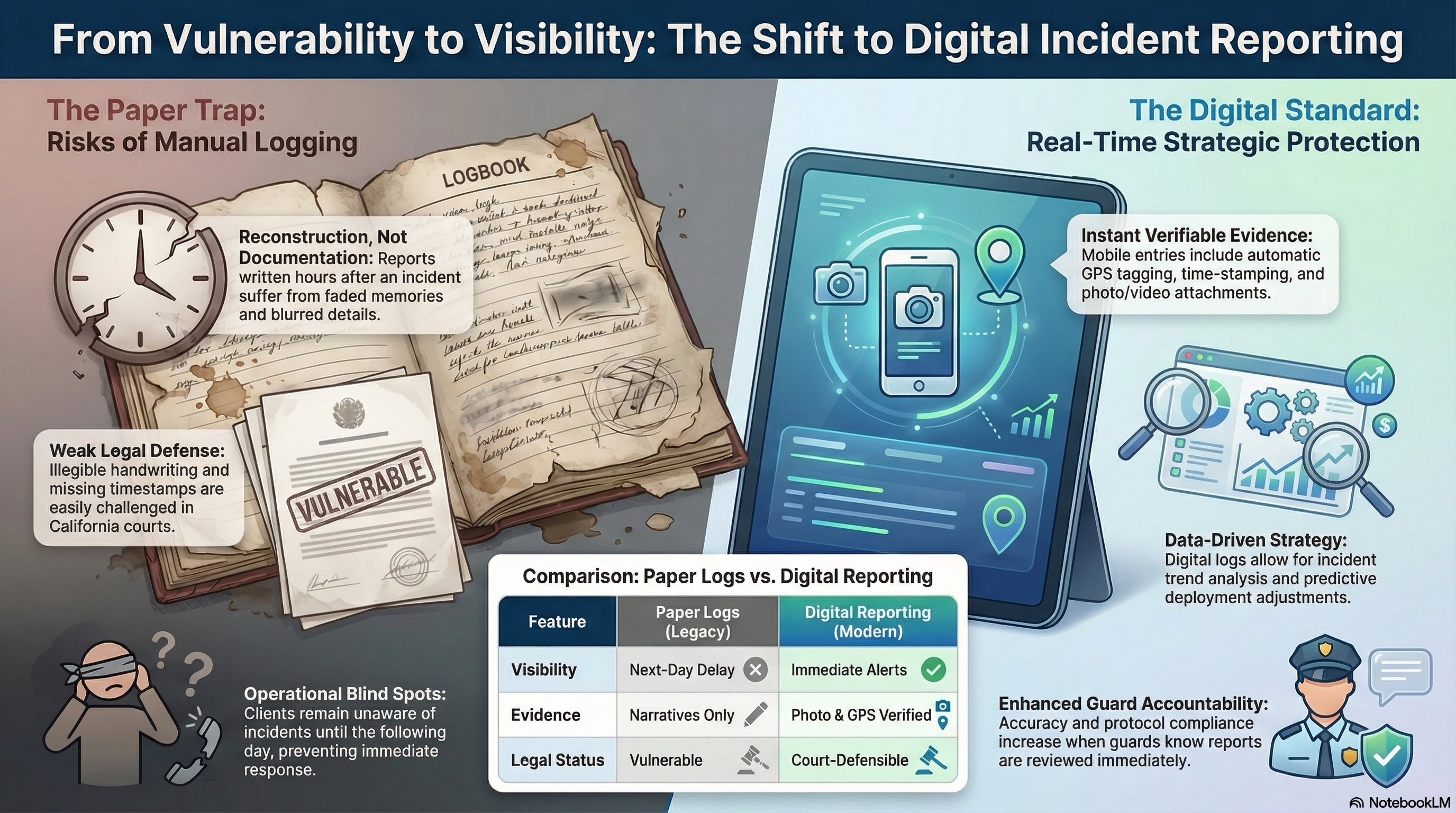
<p>Paper reporting systems create operational blind spots and legal vulnerability.</p>
<h3>1. Delayed Reporting</h3>
<ul>
<li>Critical details are forgotten</li>
<li>Timelines become inconsistent</li>
<li>Small facts become assumptions</li>
<li>Documentation gaps appear</li>
</ul>
<p>Those gaps become leverage in disputes.</p>
<h3>2. No Immediate Client Visibility</h3>
<ul>
<li>Clients don’t know what happened until the next day</li>
<li>Property managers cannot respond in real time</li>
<li>Escalation decisions are delayed</li>
</ul>
<p>Security becomes reactive instead of controlled.</p>
<h3>3. Weak Legal Defense</h3>
<p>In California’s legal environment, documentation matters.</p>
<ul>
<li>Illegible handwriting</li>
<li>Missing timestamps</li>
<li>Incomplete narratives</li>
<li>No photographic evidence</li>
<li>No location verification</li>
</ul>
<p>These weaknesses are easily challenged in court.</p>
<h3>4. No Data Aggregation</h3>
<ul>
<li>No incident trend analysis</li>
<li>No frequency tracking</li>
<li>No behavioral pattern detection</li>
<li>No predictive deployment adjustments</li>
</ul>
<p><strong>Paper logs protect no one. They only create uncertainty.</strong></p>
<hr>
<h2>What Real-Time Digital Reporting Actually Means</h2>
<p>Real-time digital reporting includes:</p>
<ul>
<li>Mobile-based incident entry at the scene</li>
<li>Automatic time-stamping</li>
<li>GPS location tagging</li>
<li>Photo and video attachment</li>
<li>Immediate supervisor notification</li>
<li>Instant client visibility</li>
</ul>
<p><strong>This is operational transparency.</strong></p>
<hr>
<h2>Why Digital Reporting Is Now the Industry Standard</h2>
<h3>1. Clients Demand Transparency</h3>
<p>California businesses expect immediate awareness of incidents on their property. Waiting until the next morning is no longer acceptable.</p>
<h3>2. Insurance Carriers Expect Documentation</h3>
<p>Claims involving:</p>
<ul>
<li>Slip-and-fall injuries</li>
<li>Property damage</li>
<li>Use-of-force incidents</li>
<li>Trespasser disputes</li>
</ul>
<p>Require detailed, time-sensitive documentation.</p>
<h3>3. Legal Scrutiny Is Increasing in California</h3>
<ul>
<li>Verified timestamps</li>
<li>Location confirmation</li>
<li>Visual documentation</li>
<li>Structured narratives</li>
</ul>
<p>Digital logs create defensible timelines.</p>
<h3>4. Operational Efficiency</h3>
<ul>
<li>Instant supervisor audits</li>
<li>Faster corrective action</li>
<li>Performance tracking per guard</li>
<li>Patrol adjustments based on data</li>
</ul>
<p>Security companies without digital systems now appear outdated.</p>
<hr>
<h2>Competitive Advantage for Your Business</h2>
<p>When your security provider uses real-time digital reporting:</p>
<ul>
<li>You receive immediate incident alerts</li>
<li>You can act before problems escalate</li>
<li>HR and legal teams receive documentation quickly</li>
<li>Recurring risks become visible through data patterns</li>
<li>Decision-making improves</li>
</ul>
<p>Security shifts from reactive coverage to strategic protection.</p>
<hr>
<h2>Accountability: Guards Perform Better With Real-Time Reporting</h2>
<p>When guards know reports are reviewed immediately:</p>
<ul>
<li>Accuracy improves</li>
<li>Protocol compliance increases</li>
<li>Detail retention strengthens</li>
<li>Shortcuts decrease</li>
</ul>
<p>Digital reporting raises the professional standard.</p>
<hr>
<h2>The Risk of Staying Paper-Based in 2026</h2>
<p>If your security company still relies on:</p>
<ul>
<li>Handwritten daily logs</li>
<li>End-of-shift summaries</li>
<li>Email-only incident updates</li>
</ul>
<p>You are:</p>
<ul>
<li>Slower to respond</li>
<li>More exposed legally</li>
<li>Less informed operationally</li>
<li>Behind modern industry standards</li>
</ul>
<p><strong>Paper systems do not scale. They do not analyze. They do not protect.</strong></p>
<hr>
<h2>How Unified Security Guard Implements Real-Time Reporting</h2>
<p>Unified Security Guard, based in Canoga Park, CA, integrates digital reporting into daily operations:</p>
<ul>
<li>Mobile-based guard reporting systems</li>
<li>Real-time supervisor oversight</li>
<li>Structured compliance documentation</li>
<li>Immediate incident notifications</li>
<li>Photo-supported reporting</li>
<li>Site-specific digital post orders</li>
</ul>
<p>Clients receive clarity — not delayed summaries.</p>
<hr>
<h2>Professional Security Is Now Data-Driven</h2>
<p>The paperless guard represents:</p>
<ul>
<li>Transparency</li>
<li>Accountability</li>
<li>Legal defensibility</li>
<li>Strategic insight</li>
</ul>
<p>In 2026 and beyond, real-time digital incident reporting is not a premium feature.</p>
<p><strong>It is the dividing line between amateur security operations and professional, compliant, modern security partners.</strong></p>
<hr>
<h2>Request a Security Assessment</h2>
<p>If your current security provider still relies on handwritten logs or delayed reporting, it may be time to reassess your risk exposure.</p>
<p><strong>Contact Unified Security Guard today to request a professional security assessment and see how modern reporting protects your business.</strong></p>