In California, Bad Security Isn’t Just Risky — It’s Legally Dangerous
California is one of the most hostile environments in the country for sloppy security operations.
High population density. Escalating retail theft. Aggressive civil litigation. Strict guard licensing laws. Zero tolerance from insurers when something goes wrong.
Yet many California businesses still treat security as a checkbox: hire a guard, post them at the entrance, and assume the problem is solved.
It isn’t.
In California, weak guard protocols don’t just invite crime — they expose you to lawsuits, regulatory violations, and insurance denial. If your guards are not operating under clear, enforceable protocols, your security strategy is already failing.
Protocol #1: Guards Must Actively Control Space — Not Just “Be Present”
Trash strategy:
“Stand here and watch the door.”
California reality:
Static guards are ineffective against organized retail theft, coordinated trespassing, and repeat offenders who know exactly how far they can push without resistance.
What this protocol requires:
-
Defined patrol zones and movement patterns
-
Timed visibility rotations during peak business hours
-
Strategic repositioning during shift changes, deliveries, and closing
-
Guards trained to identify casing behavior, not just obvious threats
If your guard can’t explain where they should be and why, you are paying for a uniform—not protection.
Protocol #2: Verbal De-Escalation Is Not Optional in California — It’s Survival
Trash strategy:
“Call the police if it escalates.”
In California, police response is delayed, selective, and often unavailable for non-violent incidents. That means your guards must control situations before they explode.
What this protocol requires:
-
Formal training in verbal command and de-escalation
-
Clear thresholds for early intervention
-
Escalation ladders that comply with California use-of-force expectations
-
Incident documentation after every verbal confrontation
Guards who can’t control situations with words either lose control—or create liability.
Protocol #3: Guards Must Be Trained for California-Specific Risks and Laws
Trash strategy:
“All guards are the same as long as they’re licensed.”
California law does not care about excuses. Improper detention, unlawful searches, or excessive force will put your business, not the guard, in court.
What this protocol requires:
-
California-compliant training on citizen’s arrest and detention limits
-
Clear policies on hands-on contact and pursuit
-
Industry-specific SOPs (retail, healthcare, construction, corporate, residential)
-
Guards trained to disengage legally, not emotionally
A guard who doesn’t understand California law is a lawsuit waiting to happen.
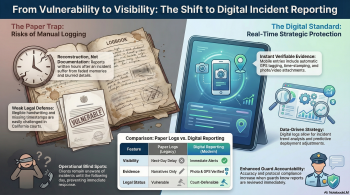
Protocol #4: Incident Reporting Must Be Court-Ready, Not Casual
Trash strategy:
“We’ll write something up if it’s serious.”
In California, everything becomes serious once attorneys get involved.
Poor reporting destroys your defense—even when your guard did the right thing.
What this protocol requires:
-
Incident reports completed before end of shift
-
Objective, fact-based language (no opinions, no assumptions)
-
Time-stamped actions and witness details
-
Supervisor review and secure record retention
If your security company can’t produce clean, consistent reports, they are exposing you.
Protocol #5: Guards Must Operate as Part of Your Business — Not Against It
Trash strategy:
“Security handles security. Staff handles everything else.”
That separation causes delays, confusion, and mistakes—especially during theft, disturbances, or employee terminations.
What this protocol requires:
-
Clear authority lines between management and security
-
Communication protocols during incidents
-
Pre-shift briefings for high-risk days
-
Alignment on customer service expectations and brand behavior
In California, a guard who treats customers poorly creates brand damage and legal risk at the same time.
Protocol #6: Supervision and Compliance Oversight Are Mandatory
Trash strategy:
“We trust the guards—we hired a company.”
Unsupervised guards drift. Protocols get ignored. Corners get cut.
What this protocol requires:
-
Random supervisory site visits
-
Performance audits and corrective actions
-
Ongoing compliance checks with California regulations
-
Client feedback loops tied to guard assignments
If no one is checking your guards, your security program is already degrading.
Conclusion: In California, Weak Security Protocols Cost More Than Crime
California businesses don’t lose money because they lack guards.
They lose money because their guards lack structure, training, and oversight.
If your security operation:
-
Relies on static presence
-
Lacks de-escalation capability
-
Ignores California legal boundaries
-
Produces weak documentation
-
Operates separately from management
-
And has no supervision
Then your security strategy isn’t just weak—it’s legally reckless.
Fix the protocols, or accept the exposure. In California, there is no safe middle ground.